
SharePoint metadata is becoming strategically important again. With the rise of Microsoft 365 Search, compliance requirements, AI-driven discovery, and enterprise reporting needs, structured metadata such as content types, managed metadata, site columns, and lookup fields is once again central to how organisations manage information.
However, while SharePoint is excellent for collaboration and document management, it is not designed to function as a reporting database. Extracting reliable analytics directly from SharePoint lists—especially when metadata relationships are involved—can quickly become complex and inefficient.
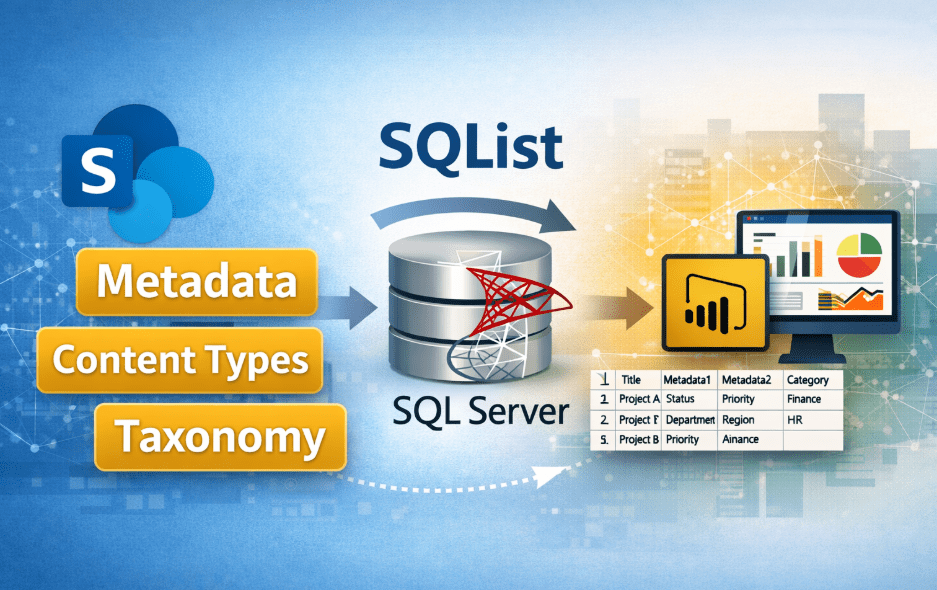
SQList by AxioWorks provides a practical approach: exporting SharePoint lists and libraries, including all associated metadata, into normalised SQL Server tables designed for reporting and integration.
Why SharePoint Is Not a Reporting Database
SharePoint stores data in a way optimised for collaboration, versioning, and security trimming—not for high-performance analytical queries. Challenges typically include:
- List view thresholds and query limitations
- Complex internal storage of managed metadata fields
- Lookup fields requiring client-side resolution
- Multi-value fields stored in non-relational formats
When reporting requirements grow—cross-site aggregation, large lists, trend analysis, Power BI dashboards—these limitations become significant.
For a deeper explanation, see:
Why SharePoint is Not a Reporting Database and What to Do Instead
Exporting SharePoint Metadata with SQList
SQList continuously synchronises SharePoint list and library data into Microsoft SQL Server. Crucially, it does not merely flatten data—it preserves and exports SharePoint metadata structures in a relational, normalised format.
This includes:
- Lookup fields converted into proper relational foreign keys
- Managed metadata (taxonomy) stored with term IDs and labels
- Choice and multi-select fields structured for SQL filtering
- Standard system metadata such as Created, Modified, and Author
The result is a SQL schema that mirrors the richness of SharePoint metadata while making it usable for structured queries and reporting tools.
The Advantages of Normalised SQL Tables
1. Performance and Scalability
SQL Server is designed for analytical workloads. Queries across millions of rows, including joins on metadata fields, run efficiently without the throttling constraints of SharePoint.
2. Reliable Relational Integrity
Lookup relationships and taxonomy references become enforceable relational joins. Reporting models become cleaner and more predictable.
3. Power BI and Advanced Analytics
With metadata stored in SQL Server, Power BI can connect using DirectQuery or Import mode without complex transformation logic. Filters, slicers, and aggregations work naturally.
4. Cross-Site Reporting
Data from multiple SharePoint site collections can be aggregated easily in SQL. Enterprise-wide dashboards become feasible without custom SharePoint queries.
5. Integration with Line-of-Business Systems
Metadata becomes accessible to ERP, CRM, and custom applications through standard SQL connections, supporting unified reporting architectures.
For a practical integration guide, see:
Integrating SharePoint Data with Line of Business Systems
Building a Single Source of Truth
By exporting SharePoint metadata into SQL Server, organisations can establish a central reporting repository. This enables:
- Consistent reporting models
- Unified cross-system analytics
- Improved governance visibility
- Clear audit trails and historical analysis
This architecture supports the creation of a reliable “single source of truth” for reporting and decision-making.
Further reading:
Single Source of Truth: Building Reliable Reporting from SharePoint Data
Conclusion
SharePoint metadata—managed metadata, content types, taxonomy fields, lookup columns—is increasingly valuable for governance, search, and AI-driven discovery. However, extracting scalable, reliable reporting directly from SharePoint remains challenging.
SQList provides a structured solution by exporting SharePoint data and metadata into normalised SQL Server tables, preserving relational integrity and enabling high-performance reporting.
The combination of structured SharePoint metadata and a robust SQL reporting layer allows organisations to maintain collaboration flexibility while achieving enterprise-grade analytics.
More information about SQList is available at:
https://www.axioworks.com/sqlist/
SharePoint #SharePointMetadata #PowerBI #SQLServer #DataIntegration #EnterpriseReporting #SQList